Friday, July 31, 2009

perspective

July 26, 2009
NyTimes CORNER OFFICE | CAROL SMITH

No Doubts: Women Are Better Managers

This interview with Carol Smith, senior vice president and chief brand officer for the Elle Group, the media company, was conducted and condensed by Adam Bryant.

Q. What is the most important lesson you’ve learned about leadership?

A. The importance of winning over employees as opposed to bossing employees. I learned that lesson very, very early — in sixth grade.

Q. Tell me about that.

A. In sixth grade, I was head of the project to create a mural for the graduating class to hang in the auditorium. That’s a big deal. And I got a clipboard, I remember, and then I had all this power and I started bossing everyone around. And within days it was apparent that I was going to have a mutiny on my hands, and I was fired from the mural. They took my clipboard away. It was a lesson I learned very early in life about the difference between being the boss and being bossy. I often tell people, “Ah, that’s a sixth-grade clipboard problem here.”

I feel I’m a leader without ever really thinking I’m a leader, which is to say that I know when I walk into a room of employees, I command a presence, but I’m always feeling like I’m part of the gang. I don’t instantly sit at the head of the table. I sit in the middle of the table, always. I don’t want to sit at the head of the table. I want to be part of the process and part of the decision.

In the end I think that if you win people over, they’ll follow you. And of course you need other qualities, like honesty, decisiveness and the ability to confront. I’m a really good confronter.

Q. What do you mean by “confronter?”

A. I have been in this career for many years and I have seen, and this is a generalization, that women are better list-makers. They will do their to-do list. They will prioritize their to-do list. They will get through their to-do list. Maybe it’s because we do shopping lists. And if we have a problem — again, as a generalization — we will confront the problem and deal with it head-on.

I think that has really made me good at managing people, because I think they always know that they’re going to get a real answer.

Q. Can you elaborate?

A. When you’re about to give someone a bad review, they pretty much know it. They might not know they know it, but they know it. Do I always start out with a positive? Yeah. But if there isn’t any positive, I’m not going to try to find it if there isn’t anything. I will always give them my point of view and my side, and I will always keep the door open to hear their side, and I will always end with, “Here’s what you have to do to correct it.”

Confrontation — meaning, “You didn’t do a good job. That presentation was bad. It didn’t work, and here’s why it didn’t work” — is so much better than walking away from a sales call saying, “Great. Got to get back to the office, O.K.?” It’s better for everyone and I’ve never understood why people won’t do it.

Q. It sounds as if you’ve thought a lot about men versus women as managers.

A. I have, I have.

Q. Please share.

A. Hands down women are better. There’s no contest.

Q. Why?

A. In my experience, female bosses tend to be better managers, better advisers, mentors, rational thinkers. Men love to hear themselves talk. I’m so generalizing. I know I am. But in a couple of places I’ve worked, I would often say, “Call me 15 minutes after the meeting starts and then I’ll come,” because I will have missed all the football. I will have missed all the “what I did on the golf course.” I will miss the four jokes, and I can get into the meeting when it’s starting.

Men also, they’re definitely better on the “whatever” side. Things tend to roll off their back. We women take things very personally. We’re constantly playing things over in our head — “What did that mean when they said that?” — when they mean nothing. And I’m certainly not immune to this. So there’s a downside to women.

Q. Any others?

A. No. Although I will say that working for all women is just as bad as working for all men. I hate an office where there aren’t men and women together. I hate it, hate it, hate it. Men and women together is the best.

Q. If women are better managers, how come there aren’t more women in the corner offices of corporate America?

A. I ask you that. I think we’d be better presidents. I mean, we’ve got a really good one right now, but I find it so puzzling. I swear I don’t know.

Q. What have you tried to do less of over time?

A. Less of the, “I want to know who did that. Who decided to give that rate to that person?” I want less of that self-righteousness. I have a little bit of that and I think I’d like to have less of that — the, “You see? I told you so.” That’s definitely something I should work on.

I would love to do more — it’s corny, but it’s true — management by walking around. It really makes a difference. I know it does. And we all get caught up with being with our own little group. We all have our comfort zone.

Q. Do you have tricks for managing your time?

A. I come to work almost every Sunday for at least four hours to go through my e-mail. I did it when it was a real in-box, and I would go through it and write notes to everyone and then hand them out on Monday, and now I do it with e-mail. I’m glad I come in on Sunday. It’s the quiet time. I get things out of the way. I’m reacting, but I’m thinking as I do it, constantly going through things. So when I come in on Monday, it’s like my vacation day. I’ve gotten my e-mail down to under 30.

Q. Any other time management techniques?

A. I don’t waste time. If you want to chat, if you want to gossip, I’ll gossip with anyone, I’ll hang out. But when I’m working, I’m working. When you sit here in my office, we work. Men don’t do that as well as women do, either. All of sudden they’re on football. All of a sudden they’re showing videos of their son’s soccer game. Then they’re telling a couple of jokes. I’m not good at jokes during meetings. I’m very focused. I’m very singularly directed.

Q. Let’s talk about hiring.

A. I am living by something I read in Cathie Black’s book [“Basic Black: The Essential Guide for Getting Ahead at Work (and in Life)”] which I sort of instinctively knew — that you’ve got to meet someone three times, and one of them better be over a meal.

You learn so much in a meal. It’s like a little microcosm of life. How they order, what they order. How are they going to give instructions to a waiter? Are they sending back the meal eight times? Can they keep the conversation going, especially if you’re hiring someone who is in sales? Are they asking smart questions?

Throughout a meal, the personality comes out, I think. Are you going to connect with us? Are you going to be part of the team, or are you going to be one of these independent players who wants to take all the credit? Are you good with assistants? Those are things you can find out in some subtle ways when you eat with someone.

Q. Any other tips on hiring?

A. Don’t hire somebody you don’t like. There is always a strong internal pressure to give a job to a person who has all the right credentials and says all the right things, even if something about her sends up little signals of alarm. They may be slight, but in my experience it is a great mistake to ignore them. Every time I went against my instincts and gave a job to someone who, though clearly capable, made me feel uneasy during the interview, it has ended badly.

Friday, July 24, 2009

westward

     "West is where we all plan to go someday. It is where you go when the land gives out and the old-field pines encroach. It is where you go when you get the letter saying: Flee, all is discovered. It is where you go when you look down at the blade in your hand and the blood on it. It is where you go when you are told that you are a bubble on the tide of empire. It is where you go when you hear that thar's gold in them-thar hills. It is where you go to grow up with the country. It is where you go to spend your old age. Or it is just where you go. 
      It was just where I went." (Robert Penn Warren, All The King's Men)

And so here I am in Austin; Austin, Texas. 

Thursday, July 16, 2009

yes

It takes a crane to build a crane
It takes two floors to make a story
It takes an egg to make a hen
It takes a hen to make an egg
There is no end to what I'm saying

It takes a thought to make a word
And it takes some words to make an action
It takes some work to make it work
It takes some good to make it hurt
It takes some bad for satisfaction

It takes a night to make it dawn
And it takes a day to make you yawn brother
And it takes some old to make you young
It takes some cold to know the sun
It takes the one to have the other

And it takes no time to fall in love
But it takes you years to know what love is
It takes some fears to make you trust
It takes those tears to make it rust
It takes the dust to have it polished

It takes some silence to make sound
It takes a loss before you found it
And it takes a road to go nowhere
It takes a toll to make you care
It takes a hole to make a mountain

Ah la la la la la la life is wonderful
Ah la la la la la la life goes full circle
Ha la la la la la life is wonderful
Ha la la la la la life is meaningful
Ha la la la la la life is wonderful
Ha la la la la la life it is...so... wonderful
It is so meaningful
It is so wonderful
It is meaningful
It is wonderful
It is meaningful
It goes full circle
Wonderful
Meaningful
Full circle
Wonderful

-Jason Mraz

Wednesday, July 15, 2009

pointless laws

"…Skydiving was definitely the scariest thing I’ve ever done. Let me ask you this question in regards to the skydiving: what is the point of the helmet in the skydiving? I mean, can you kinda make it? You jump out of that plane and that chute doesn’t open, the helmet is now wearing you for protection. Later on the helmet’s talking with the other helmets going “It’s a good thing that he was there or I would have hit the ground directly.”

There are many things that we can point to that proof that the human being is not smart. The helmet is my personal favorite. The fact that we had to invent the helmet. Now why did we invent the helmet? Well, because we were participating in many activities that were cracking our heads. We looked at the situation. We chose not to avoid these activities, but to just make little plastic hats so that we can continue our head-cracking lifestyles.

The only thing dumber than the helmet is the helmet law, the point of which is to protect a brain that is functioning so poorly, it’s not even trying to stop the cracking of the head that it’s in…"

-Jerry Seinfeld 

Tuesday, July 7, 2009

History

"If the human race didn't remember anything it would be perfectly happy. I was a student of history once in a university and if I learned anything from studying history that was what I learned. Or to be more exact, that was what I thought I had learned." 
Robert Penn Warren, All the Kings Men

So if the human race didn't remember anything we wouldn't have a  sense of history. Thus, we would have nothing to which to compare our daily events or sense of "progress." Therefore, how could we achieve perfect happiness? Or is happiness not relative to anything other than pure experience of emotion in the moment it occurs? 

What would the human race be without a sense of history? 

Is the human race unhappy? 

On the day of Michael Jackson's funeral it seems fitting to think of these questions in light of his life and legacy. He was a star of unique magnitude - no one denies that. Yet, is it easier to remember only the happy and pleasant memories so that history will be kind to him? Is that the easy option or the best one? 

Monday, July 6, 2009

Evangelism Tool? Lazy Outreach? Discuss.

NY Times, July 5, 2009

Lead Us to Tweet, and Forgive the Trespassers

Things went smoothly for the first hour of the Twitter experiment at Trinity Church in Manhattan on Good Friday in April.

While hundreds of worshipers watched the traditional dramatization of the Crucifixion from pews in the church, one of New York’s oldest, thousands more around the world followed along on smartphones and computers as a staff member tweeted short bursts of dialogue and setting (“Darkness and earthquake,” “Crucify him!”).

The trouble began in the second hour.

Twitter’s interactivity — its essence — made it easy for an anonymous text-messager to insert an unscripted character into the Passion play: a Roman guard who breezily claimed, “I’ve got dibs on his robe.” When another texter introduced a rogue Mary Magdalene, the intrusion only confirmed the obvious: Twitter’s trademark limit of 140 characters per message is no bar against crudity.

Religious groups from Episcopalians to Orthodox Jews have signed up for Twitter, Facebook and other social media networks with the same gusto that celebrities and politicians have, and for some of the same reasons — to gain a global platform and to appeal to young people.

Still, many clerics admit to an uneasiness about the merger of worship and electronic chatter.

In online debates and private discussions, leaders of all faiths have been weighing pros and cons and diagramming the boundaries of acceptable interactions: Should the congregation have a Facebook page, or should it be the imam’s or priest’s? Should there be limited access? Censoring? Is it appropriate for a clergy member to “friend” a minor?

Some recoil at the informality and unpredictability of the crowds marshaled by social media, and at their seeming immunity — even hostility — to the authority of established institutions. More deeply, some in the clergy see a basic tension between the anonymous world of online life and the meaning of religious community.

“In Judaism, we believe that God resides in the community — among people in the same room at the same time, hearing each other’s voices and looking in each other’s eyes,” said Rabbi Gerald C. Skolnik of the Forest Hills Jewish Center in Queens, who also wanted it known that he carries an iPhone and a laptop and is talking with his congregation about a Facebook page. “But can you tweet a minyan?” he asked, referring to the quorum of 10 people required for most Jewish devotions. “I don’t think so.”

Religious groups are answering many such questions for themselves — and, for the most part, signing up for interactive media, said the Rev. Bill Reichart, a Presbyterian minister in Atlanta who leads an informal network of Web consultants who work with people of a broad spectrum of faiths.

“If total control is what you want, social media will frustrate you,” he said, reprising his advice to the clergy. “But the trade-off is the ability to hear and learn, reach out in new directions.” Many clerics, desperate to connect with young people, have been like radio dispatchers using the wrong bandwidth, he said. “The young don’t do e-mail anymore,” he said. “They do Facebook.”

Evangelical Christian ministers were among the earliest Web networkers, and today, popular preachers like Rick Warren and Joel Osteen have thousands of followers on Twitter. At Christ Tabernacle Church in Queens, Pastor Adam Durso and his brother Chris, the youth director, keep in contact with their flock, sometimes hourly, on a half-dozen social media sites.

Leaders in other faiths are catching on, but moving slowly, said Monique Cuvelier, the chief executive of Talance, a web development firm in Boston, who attributes some of the resistance to the conservatism of any established institution, and some to a sense of privacy: Gossiping about the rabbi’s wife may be common in temple parking lots, “but having it end up on the Internet — that freaks some people out,” she said.

Lisa Colton, president of Darim Online, a consultancy that works with Jewish congregations, said some rabbis worry that a Facebook page might attract anti-Semitic graffiti.

The anxieties are different for every group. Some Muslim clerics have told followers to avoid making statements on social networking sites that antiterrorist investigators might misinterpret as suspicious.

The sites are assumed to be irresistible listening posts, said Farid Senzai, research director for the Institute for Social Policy and Understanding, a Middle East policy group. Some imams advise people to avoid discussing politics, and especially to avoid mentioning Afghanistan or Pakistan, even if they have relatives there, he said.

For Roman Catholics, whose tradition requires every church in the world to follow the same liturgical script on any given Sunday, the main issue is message control. “It gets messy,” said Joseph Zwilling, a spokesman for the Archdiocese of New York. “When people can post comments on your site, things can degenerate unless you are constantly monitoring.”

All the same, Pope Benedict XVI opened his own Facebook page in May. It has attracted about 62,000 fans, whose uncensored greetings, requests and occasional insults appear on its “wall,” or comment board.

Experts say there are many degrees of openness for religious groups tuning into social media. Some carefully restrict access and even require proof of membership. Others, like Westwinds Community Church in Jackson, Mich., do not. There, Twitter comments appear on monitors behind the pulpit during services. (Some recent tweets: “Nice shirt, pastor!” and “Jesus is a joke.”)

At Trinity Church, an Episcopal congregation with an adventurous approach geared to the culture of Wall Street, where it is located, the Passion play experiment was considered a success despite the interloping characters. “If someone chooses to interact with us mischievously, that’s fine,” said the Rev. Canon Anne Mallonee, the church vicar. “The opposite of engagement is not mischief, but apathy.”

Since Good Friday, Trinity has been tweeting its Sunday services to a small but growing group of followers (525 as of Wednesday) from Europe to California, including some who live closer by. A church employee transmits snippets of the service in real time — tweets like “God be with you” or “Inspire us with your holy spirit.”

“I’m a sporadic worshiper,” said Anne Libby, a management consultant in Manhattan who often follows the services on Twitter between occasional visits to Trinity. The connection, however slender, has drawn her closer to the church community, she said. She has never tweeted back during a service. She does not always follow every word. But she has noticed that her favorite Bible quotation fits nicely within the 140-character Twitter limit: “Love your neighbor as yourself,” she said.

Sunday, July 5, 2009

Orange Mushrooms


Everyone needs a place and a people set apart. No matter how much time passes before you're able to see folks again, the richness of the friendships are only enhanced.  

"Real world" indulgences aren't the makings of relationships, and only rarely arise in conversation. Instead, it's the matters of the soul that can be found on the lips and in the ears of all those gathered. It's a place where the smells in the most insignificant corners bring back vivid memories. The taste of the meals transport you to a different moment in time. It's people and places like this who remind me what life is really all about. 

Immeasurable amounts of fun were had by all this weekend! I'm happy to report that the World successfully defeated the Staff team in the Frisbee game of the year. Surely, the fogies only mounted a challenge because they have been working so hard 24 hours a day all summer long. The skill-level was at an all-time high on both squads. Seldom Scene rocked the Bluegrass Festival on its 20th Anniversary. Former directors, staff members, and campers came from all over to celebrate Bishop Lee's final 4th in the Diocese. And, I'm happy to report that HOSS still rules. Guest soloist James Gunter was the highlight of the evening with his dynamite performance of "Superman." There were even a few stray fireworks and sparklers to close out the evening. 

For friends both old and new, bands both good and better, sunshine and drizzle, campers present and those gone before, we lift our voices in thanksgiving to the skies. 

"Lift your voice. 
Lift your praise. 
Alleluia to God." 

Friday, July 3, 2009

Independence Day

What makes the grass grow? 
Blood. 
Blood. 
Blood. 

Staff vs. the World
July 4, 2009
Shrine Mont, Orkney Springs, VA

Bring. It. On! 

Wednesday, July 1, 2009

simple summer

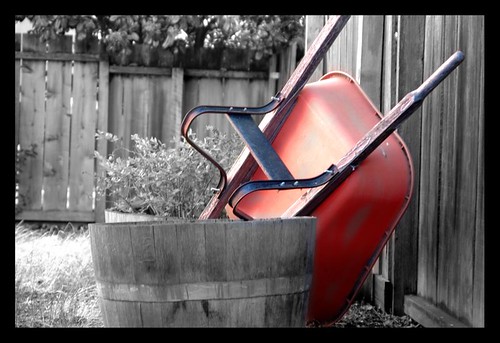
The Red Wheelbarrow 
William Carlos Williams 

so much depends
upon

a red wheel
barrow

glazed with rain
water

beside the white
chickens.