
Tuesday, October 28, 2008
Modern Inequality
What does it mean to be subject to the norms of society - both in principle and in our daily lives? As a young woman getting read to enter the job market, I have already seen a few real challenges. I was talking with a female graduating senior tonight who was reflecting about an experience at a reception with a company for a job interview. As she was standing in a group of men listening to one person talk, she realized she was getting edged out of the circle. Her arms were crossed and her feet were taking up little space. As she realized that this was happening, she put her hands on her hips and stood with her feet shoulder width apart. She distinctly reclaimed her place in the circle. Stories like hers are not uncommon. I do recognize that the equal opportunities are much more readily available today than decades ago. Yet, there are still implicit and explicit barriers. How does one begin to play within the system for the sake of getting by, yet not remain complacent to unfair treatments and policies? I hate the idea of asking for an exception for any reason - the idea that I might not be able to play by the same rules by which others abide. So when is it asking for an exception, and when is it reacting to the realities of inequality?

Wednesday, October 22, 2008

"Heart of Gold"
I want to live,
I want to give
I've been a miner for a heart of gold.
It's these expressions I never give
That keep me searching for a heart of gold
And I'm getting old.
Keeps me searching for a heart of gold
And I'm getting old.
I've been to Hollywood
I've been to Hollywood
I've been to Redwood
I crossed the ocean for a heart of gold
I've been in my mind,
it's such a fine line
That keeps me searching for a heart of gold
And I'm getting old.
Keeps me searching for a heart of gold
And I'm getting old.
Keep me searching for a heart of gold
Keep me searching for a heart of gold
You keep me searching for a heart of gold
And I'm growing old.
I've been a miner for a heart of gold.
-Neil Young
-Neil Young

Tuesday, October 21, 2008
Chickens...or Dogs?
 I started reading this book on the way home from New Mexico on Saturday afternoon. I'm quite addicted, and almost finished. It's written from the perspective of a 15-year old autistic narrator, Christopher. Christopher is incredibly gifted mathematically, has a photographic memory, and has a knack for murder mystery stories. When a murder happens in his own neighborhood, he sets out to solve the crime on his own. In the process, he discovers the ugly truths about neighbors and family members. [You should probably stop reading here if you don't want me to ruin the rest of the novel for you.] Along with being completly taken by Christopher's talents and personality, his character has also made me wonder how honest we are with one another in every day life. It's easy to assume that his mother and father were dishonest about extra-marrital affairs and the consequences becuase Christopher is autistic. But I feel like his character is sharing deeper truths with us. In efforts to be polite and politically correct, I often feel like we're doing a deeper disservice to one another by not sharing the whole truth. Yet, are our actions any more innocent than that of Christopher's parents who are seemingly attempting to protect their son?
 I'm reminded of a conversation I had with a friend a few months ago where I was called out for making polite platitudes for the sake of saving her feelings. At the time I had thought I was doing the right thing. But I do wonder if it wouldn't have been better to speak the truth in full. I think my hesitancy to share the full truth was for fear of how that person would react in the moment. What is this fear that has seemingly taken a hold of us to remain polite and courteous even to those with whom we are close? What is it that has become so unacceptable about disagreeing with one another? After all, isn't it through difference that we are strengthened by those around us? Maybe I'm the only one that has turned into a chicken...
Tuesday, October 14, 2008
Where We Are Not
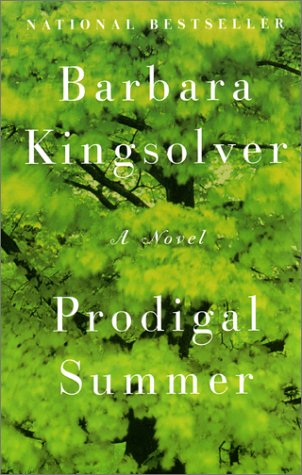 Lately I've been reading one of Barbara Kingsolver's novels, The Prodigal Summer. I really wanted to like The Poisonwood Bible, and was unfortunately disappointed. When I found this one on the shelf of a used book store, I decided I would give it a try. I think I was drawn to it becuase it's set in the Southern Applachian mountains. Having spent my summers in the Shenandoah Valley, I have an idealistic picture of pristine mountain life. Everything seems to be simpler - waking up with the sun, spending time on your own land, growing food that you will later eat, and knowing all your neighbors. The opportunity to be reminded daily how small you are in comparison to the beautiful peaks that loom in the near distance seems idyllic. Yet, do all of these seeming attractions ignore the hard work that goes into farming, or real possibility of lonliness that comes with country life? I guess what I'm wondering is whether I simply have a case of "the grass is always greener on the other side." It might be that simple. But having grown up in suburbia, and living in a small city now, I can honestly say that I'm far from settled. Maybe I would hate the country if I actually lived there. I guess the larger question that
 's looming in my mind is whether we ever really settle down? Is there always going to be somewhere else we wish we'd been or might still go? Or do we find a place where our hearts and bodies are truly content to simply be? For now, I'll continue to enjoy the lush descriptions and farm tales of Kingsolver's novel, while sporting my brand new ass-kickin boots. Country life remains a simple fantasy. Where I am not is perhaps only a preview of what is to come.
 Monday, October 13, 2008
It's a bird! It's a Ballon! It's a Kite....
 This week, I have chosen to enjoy my luxurious Fall Break in Albuquerque, New Mexico. It was the destination for my fabulous vacation because it coincided with the 2008 Albuquerque International Balloon Fiesta. I got to attend last year, and was surprised how exciting it was to be amid thousands of hot air balloons. It was the closest I've ever come to living in a fairytale. The colors, the size, and the magic of the sunrise Mass Ascension was memorable. This year, it just wasn't meant to be. Due to high winds and inclement weather, the Fiesta was cancelled for the entirety of my visit. On the last day of the Fiesta, we decided that we'd go down to the balloon park...just in case. Deliciou
 s breakfast burritos were consumed, and hot chocolate enjoyed while wrapped in our blanket, sitting on the empty balloon park field. As the sun came up over Sandia peak, balloonists and their crews were streaming out of the park in droves. Though we enjoyed our sunrise picnic, the sky had never looked so empty. Several creative balloon enthusiast had come with a backup plan - kites! In an over sized field poised for monstrous balloons, four lonely kites glided through the sky. Yet, it was enough to make me smile at the beauty in disappointment. And...who's to say that buying gobs of helium balloons from the party store and dancing in my own fiesta of balloons wouldn't be more fun?!?! (Pictures are from the 2007 Balloon Fiesta)
Subscribe to:
Comments (Atom)

