Sunday, January 18, 2009

a glimpse into "Plain" life

So I have to admit, reading Jodi Piccoult novels is one of my guilty pleasures. I've read quite a few of them. This one was quite good, though not my favorite (Nineteen Minutes & Sister's Keeper still occupy those spots.)

"Plain Truth" is about an Amish girl who is put on trial for murdering her own baby. Catch is, the Amish aren't allowed to be violent, so the question is raised as to whether it is even possible that this 19 year old would have thought to commit such a crime. Deeper at the heart of the novel is the question of religious dedication and adherence. Whether or not the young girl, Katie, actually committed the crime remains a secret for most of the novel. Regardless, it is suggested that whether or not she is guilty, she should surrender herself to the mercy of the community and be banned for a short period of time. After asking forgiveness, she will be fully accepted back into the community once her bann is over. It seems to me there comes a point in time when submitting to the will of the community on principle alone is no longer a moral course of action.

Furthermore, in the case of the Amish, they live a "plain" life, not submitting to English cultural mechanisms or ways of life. Thus, is it fair to ask them to be a part of an English court system, when they have their own means for dealing with crimes? In one sense, murdering a newborn is a crime, regardless of whether it's English or Amish. Yet, is it a double standard to allow the Amish to live within their own societies in all other instances, except those which break the English law?

Like many of Piccoult's novels, this story has a savior - and an unexpected one at that. She always raises the question as to what the role of the savior is in literature and culture - both in myth and actuality.
All in all, clearly raised a lot of questions for me on a variety of topics. Regardless, an enjoyable and thought-provoking read.

Saturday, January 10, 2009

From the Pulpit

So, this article was in the NY Times today. As someone who is on the track to be ordained as a priest, I find it pretty disturbing. Are there rules about pastoral or religious integrity? As in, are there just some things that priests or pastors simply shouldn't say or do? How does such a "hip" pastor get away with condemning "modern" views like gender equity? Would you want Mark Driscoll to be your pastor?
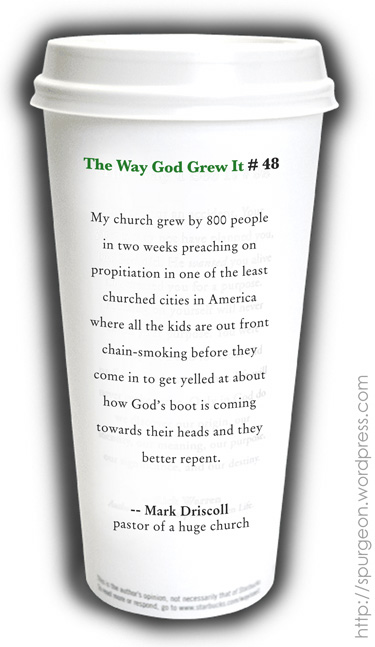
Who Would Jesus Smack Down?
Published: January 6, 2009

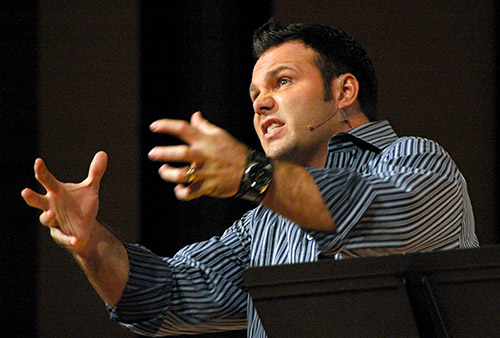
Mark Driscoll’s sermons are mostly too racy to post on GodTube, the evangelical Christian “family friendly” video-posting Web site. With titles like “Biblical Oral Sex” and “Pleasuring Your Spouse,” his clips do not stand a chance against the site’s content filters. No matter: YouTube is where Driscoll, the pastor of Mars Hill Church in Seattle, would rather be. Unsuspecting sinners who type in popular keywords may suddenly find themselves face to face with a husky-voiced preacher in a black skateboarder’s jacket and skull T-shirt. An “Under 17 Requires Adult Permission” warning flashes before the video cuts to evening services at Mars Hill, where an anonymous audience member has just text-messaged a question to the screen onstage: “Pastor Mark, is masturbation a valid form of birth control?”

Driscoll doesn’t miss a beat: “I had one guy quote Ecclesiastes 9:10, which says, ‘Whatever your hand finds to do, do it with all your might.’ ” The audience bursts out laughing. Next Pastor Mark is warning them about lust and exalting the confines of marriage, one hand jammed in his jeans pocket while the other waves his Bible. Even the skeptical viewer must admit that whatever Driscoll’s opinion of certain recreational activities, he has the coolest style and foulest mouth of any preacher you’ve ever seen.

Mark Driscoll is American evangelicalism’s bĂȘte noire. In little more than a decade, his ministry has grown from a living-room Bible study to a megachurch that draws about 7,600 visitors to seven campuses around Seattle each Sunday, and his books, blogs and podcasts have made him one of the most admired — and reviled — figures among evangelicals nationwide. Conservatives call Driscoll “the cussing pastor” and wish that he’d trade in his fashionably distressed jeans and taste for indie rock for a suit and tie and placid choral arrangements. Liberals wince at his hellfire theology and insistence that women submit to their husbands. But what is new about Driscoll is that he has resurrected a particular strain of fire and brimstone, one that most Americans assume died out with the Puritans: Calvinism, a theology that makes Pat Robertson seem warm and fuzzy.

Yet his message seems radically unfashionable, even un-American: you are not captain of your soul or master of your fate but a depraved worm whose hard work and good deeds will get you nowhere, because God marked you for heaven or condemned you to hell before the beginning of time. Yet a significant number of young people in Seattle — and nationwide — say this is exactly what they want to hear. Calvinism has somehow become cool, and just as startling, this generally bookish creed has fused with a macho ethos. At Mars Hill, members say their favorite movie isn’t “Amazing Grace” or “The Chronicles of Narnia” — it’s “Fight Club.”

Mars Hill Church is the furthest thing from a Puritan meetinghouse. This is Seattle, and Mars Hill epitomizes the city that spawned it. The front desk, black and slick, looked as if it ought to offer lattes rather than Bibles and membership pamphlets. Buzz-cut and tattooed security guards mumbled into their headpieces and directed the crowd toward the auditorium, where the worship band was warming up for an hour of hymns with Bruce Springsteen’s “Born to Run.”

On that Sunday, Driscoll preached for an hour and 10 minutes — nearly three times longer than most pastors. As hip as he looks, his message brooks no compromise with Seattle’s permissive culture. New members can keep their taste in music, their retro T-shirts and their intimidating facial hair, but they had better abandon their feminism, premarital sex and any “modern” interpretations of the Bible. Driscoll is adamantly not the “weepy worship dude” he associates with liberal and mainstream evangelical churches, “singing prom songs to a Jesus who is presented as a wuss who took a beating and spent a lot of time putting product in his long hair.”

God called Driscoll to preach to men — particularly young men — to save them from an American Protestantism that has emasculated Christ and driven men from church pews with praise music that sounds more like boy-band ballads crooned to Jesus than “Onward Christian Soldiers.” What bothers Driscoll — and the growing number of evangelical pastors who agree with him — is not the trope of Jesus-as-lover. After all, St. Paul tells us that the Church is the bride of Christ. What really grates is the portrayal of Jesus as a wimp, or worse. Paintings depict a gentle man embracing children and cuddling lambs. Hymns celebrate his patience and tenderness. The mainstream church, Driscoll has written, has transformed Jesus into “a Richard Simmons, hippie, queer Christ,” a “neutered and limp-wristed popular Sky Fairy of pop culture that . . . would never talk about sin or send anyone to hell.” Mars Hill is “a reaction to the atheological, consumer-driven nature of the modern evangelical machine.”

Driscoll disdains the prohibitions of traditional evangelical Christianity. Taboos on alcohol, smoking, swearing and violent movies have done much to shape American Protestant culture — a culture that he has called the domain of “chicks and some chickified dudes with limp wrists.” Moreover, the Bible tells him that to seek salvation by self-righteous clean living is to behave like a Pharisee. Unlike fundamentalists who isolate themselves, creating “a separate culture where you live in a Christian cul-de-sac,” as one spiky-haired member named Andrew Pack puts it, Mars Hillians pride themselves on friendships with non-Christians. They tend to be cultural activists who play in rock bands and care about the arts, living out a long Reformed tradition that asserts Christ’s mandate over every corner of creation.

Like many New Calvinists, Driscoll advocates traditional gender roles, called “complementarianism” in theological parlance. Men and women are “equal spiritually, and it’s a difference of functionality, not intrinsic worth,” says Danielle Blazer, a 34-year-old Mars Hill member. Women may work outside the home, but they must submit to their husbands, and they are forbidden from taking on preaching roles in the church.

Driscoll’s theology “changed how I view women,” Conklin says. He quit going to strip clubs and now refuses to tattoo others with his old specialty, pinup girls (though he still wears two on one arm, souvenirs from earlier, godless days). Mars Hill counts four of the city’s top tattoo artists among its members (and many of their clientele — that afternoon, Conklin was expecting a fellow church member who wanted a portrait of Christ enthroned across his back). While other churches left people like Conklin feeling alienated, Mars Hill has made them its missionaries. “Some people say, ‘You’re pretty cool and you’re a Christian, so I guess I can’t hate all of them anymore,’ ” he says. “I understand where they’re coming from.
Mars Hill — with its conservative social teachings embedded in guitar solos and drum riffs, its megachurch presence in the heart of bohemian skepticism — thrives on paradox. Critics on the left and right alike predict that this delicate balance of opposites cannot last. Some are skeptical of a church so bent on staying perpetually “hip”: members have only recently begun to marry and have children, but surely those children will grow up, grow too cool for their cool church and rebel.


Thursday, January 8, 2009

Natural Instincts

So, while I'm working on finding my voice, I'll rely on other folks who seem to have found theirs quite well. I found this article today, and much of it resonated with me. Winter is a big struggle for me - the darkness, and especially the cold. But it does mean there's warmth and promise on the horizon. Egan seems to have done a masterful job of capturing that sentiment. Enjoy!

Hibernation Blues

Timothy Egan, NY Times
January 7, 2009, 10:00 pm

PORT ANGELES, Wash. — A few days into the new year, I stood outside the house and stared into the darkness of a deep winter night at this far western edge of America – defiant on a bone-chilling eve.

It felt lonely and hypnotic here on the Olympic Peninsula, where a jut of land the size of Massachusetts holds an immensity of snow, surrounded on three sides by unknowable depths of gunmetal-gray salt water.

At this northern location, at a latitude equal to Newfoundland, it’s hard not to feel the seasonal blues in all their smothering inevitability. Because there were no big-city lights on the horizon, and clouds veiled a thin moon, the darkness had a particularly strong grip.

I wanted to get inside by the fire, to drink something strong, to eat something sweet, to find a bear’s den of deep sleep. If you live in the north, in places where the sun is an unreliable companion for many months, you can’t escape the urge to hide and hoard in winter.

But this year, I’ve decided to fight lethargy with logic, to welcome the new president, the babies just born, to see something other than closure, dormancy and loss in the annual dark season.

It’s tough, and perhaps absurd, to battle biological imperative. I crave light, pruning high up in the trees around my house to open more patches of sky, keeping the strings of Christmas luminescence hanging into January’s bleakness, checking the daily sunset tables for those few jumps of the clock that will hold back the curtain of night until 4:35 p.m., instead of 4:33.

Friends suffer from that dreaded affliction, Seasonal Affective Disorder, the aptly named SAD. They park themselves next to south-facing windows by day, and full spectrum, 10,000 lux light boxes by night. They escape to the desert or the beach to the south. Still, for most of us, some variant of depression brought by the prevailing gloom of short days cannot be kept at bay.

Rage is another reaction. In Spokane, where six feet of snow has fallen in the last three weeks, a man was just arrested for shooting at a snow plow operator (no injuries, he missed), and mental health clinics say they are getting twice the number of calls they usually get.

“Man is the only animal that blushes,” Mark Twain famously said. “Or needs to.” We stand out in another way, as well: we can’t hibernate, unlike many of our fellow animals. Creatures that are capable of slowing their metabolic rates and lowering their body temperatures can close the whole shebang down for a few months, living off stored body reserves through the long winter.

Sad to say, we can’t generate heat from fat. The only way to get warmer during a season of sloth is to be active.

As a country, we’ve been through a long winter – endless, in some regards. Our departing president told us to shop in a time of war, to spend what we didn’t have, to act as if sacrifice was no longer a national character trait.

During that long winter, when everything was supposed to be sunshine, we bought homes we could not afford. We invested in funds that could not sustain themselves. We made hits out of television shows in which we watched other people lose weight – virtual virtue.

Our leaders fostered a certain amnesia about our history, trying to get us to forget that we don’t torture, that we don’t hold people without trial, that we were founded by rebels demanding basic human dignity.

That winter will soon be gone, leaving us with a terrible toll. The federal deficit is now projected to be $1.2 trillion this year, even without a stimulus package. New jobless numbers on Friday will make us shudder. It will take years to sort the mess and lift the gloom.

And then there is fresh war in a place of ancient hatreds. What else could winter bring?

But even with a reckoning at home and the killings overseas, I’ve chosen to embrace the few ticks of extra daylight coming on every day, in that Washington and this Washington. Action is generating heat, as it should, following the laws of nature for animals that can’t hibernate.

When the world is muffled, at its darkest, there lies possibility, if only for a sunless day.

Monday, January 5, 2009

Bird by Bird

So I started reading this book a few months ago, and have enjoyed it, despite the fact that it's taken me a while. It's not necessarily a page turner, but enjoyable to read Ann Lamott's thoughts on writing and life. I have read other religious works by her, and was interested to read something about the art of writing. My New Year's resolution is to write every day, even if only a little bit. But also to try new kinds of writing - poetry, creative writing, who knows! Mainly, I want to work on "finding my voice," as they say. Bird by Bird was helpful in thinking about the different ways to go about approaching this this project.

Here are some of my favorite passages from the book, which will hopefully get you interested as well!
"You can safely assume you've created God in your own image when it turns out that God hates all the same people you do."
"A big heart is both a clunky and a delicate thing; it doesn't protect itself and it doesn't hide. It stands out like a baby's fontanel, where you can see the soul pulse through."
"The truth of your experience can only come through in your own voice. If it is wrapped in someone else's voice, we readers will feel suspicious, as if you are dressed up in someone else's clothes. You cannot write out of someone else's big dark place; you can only write out of your own.

"Here is the best true story on giving I know, and it was told by Jack Kornfield of the Spirit Rock Meditation center in Woodacre. An eight-year-old boy had a younger sister who was dying of leukemia, and hew as told that without a blood transfusion she would die. His parents explained to him that his blood was probably compatible with hers, and if so, he could be the blood donor. They asked him if they could test his blood. He said sure. So they did and it was a good match. They they asked if he would give his sister a pint of blood, that it could be her only change of living. He said he would have to think about it overnight. The next day he went to his parents and said he was willing to donate the blood. So they took him to the hospital where he was put on a gurney beside his six-year-old sister. Both of them were hooked up to IVs. A nurse withdrew a pint of blood from the boy, which was then put int eh girl's IV. The boy lay on his gurney in silence while the blood dripped into his sister, until the doctor came over to see how he was doing. Then the boy opened his eyes and asked, 'How soon until I start to die?' Sometimes you have to be that innocent to be a writer. Writing takes a combination of sophistication and innocence; it takes conscience, our belief that something is beautiful because it's right."

Sunday, January 4, 2009

"The Other"

This latest novel from David Guterson, who also wrote the well-known book Snow Falling on Cedars, was enjoyable to read. The style of his prose is sometimes dense, but delightfully flowery for the most part. Guterson's talent as a writer was more compelling than the characters or plot for me. This book was originally reviewed in comparison to the popular story, Into the Wild, with a main character who takes off into the wilderness recklessly and permanently (depending on who you ask.) I suppose I am intrigued by these tales because of my current stage of young-adulthood and its accompanying transitoriness. Also, because of the consequent moral questions that come with abandoning societal luxuries that such a course of action demands be confronted. In the end, I much prefer Jon Krakauer's take on Christopher McCandless than John William Barry of Guterson's novel. John William is a product of a prominently wealthy Seattle family. Narrated from the point of view of his best friend from childhood, the reader explores drastically different ways of "wealthy" living. Although it was enjoyable to entertain the varying life choices and consequences with these characters, the ending was a huge letdown. (You should probably stop reading now if you don't want me to spoil it for you.) Ultimately, in the wake of John William's death, his best friend speaks with his parents and countless others who reveal that John William may have suffered from sort of mental illness from early childhood. His eccentricities are merely chalked up to neglect at a young age. Ultimately, the question Guterson leaves us with is one of nature vs. nurture. Could such a thing drive a highly intelligent and accomplished young man to become a hermit in the woods to the point of death? If so, is that the worst that could have happened to him? Or the best?